
 248-250-8937
 519-999-9723
 +1 844 686-0671
5-Axis Workholding Guide: How to Choose the Right Vise, Zero-Point System, Dovetail or Fixture
A 5-axis CNC can reach more of the part in one setup, but only if the workholding stays out of the way. That is where many otherwise good setups start to struggle.
A vise that feels perfectly normal on a 3-axis mill can suddenly block a toolpath, force too much part stick-out, or leave the spindle fighting for clearance once the table begins to tilt and rotate. The result is often the opposite of what you wanted from a 5-axis machine: extra setups, awkward tool lengths, and more time spent working around the fixture.
| Quick answer: There is no single best 5-axis workholding system. A self-centering vise is usually the most flexible starting point. Dovetail workholding gives you more access near the bottom of the part. Zero-point systems make fixture changes faster and more repeatable. Pyramids and tombstones help when the goal is to load more work and keep the machine cutting longer. |
The right choice depends on the part, the cutting forces, how often the setup changes, and how you want the machine to run. Before choosing a fixture, look at the complete setup rather than the vise by itself.
Why Is Workholding Different on a 5-Axis CNC?
Traditional 3-axis machining is much more forgiving about what sits around the workpiece. Most of the cutting happens from above, so a standard machinist vise can grip a large section of the part without becoming a major obstacle.
On a 5-axis machine, the spindle may approach from the top, the side, or at an angle. The table or workpiece may also rotate toward the spindle. That means the fixture has to do two jobs at the same time: hold the part securely and leave enough open space for the tool, holder, and spindle to move around it.
This is the balancing act behind most 5-axis workholding decisions. You want enough contact to keep the part stable, but not so much fixture around the workpiece that you lose the accessibility you bought the machine for.
That is why compact vises, elevated setups, low-profile bases, dovetail fixtures, and zero-point systems show up so often in 5-axis machining. They are not automatically better than a conventional vise. They simply solve a different set of problems.
1. Self-Centering Vises: The Most Flexible Starting Point
For many job shops, a self-centering vise is the easiest place to start when building a 5-axis workholding setup.
Instead of keeping one jaw fixed, both jaws move toward the center. The part is clamped around the vise centerline, which can make setup and programming more consistent when you are running families of similar parts.
The other advantage is simple: most 5-axis self-centering vises are designed to be compact. That gives the cutting tool more room around the workpiece than a large conventional machine vise would.
They work especially well for rectangular stock, symmetrical parts, prototypes, short production runs, and high-mix work where the next job may use a completely different part size.
A self-centering vise is a strong fit when:
- Part sizes change frequently.
- You need access to several sides of the workpiece.
- Repeatable centering matters from part to part.
- You want one fixture that can handle more than one job.
- You plan to mount the vise on a zero-point base later.
RHS offers compact and larger self-centering vise bodies, including 210 mm, 255 mm, and 350 mm options. That range matters because a bigger vise is not automatically a better vise. The goal is to use enough fixture for the part without giving away unnecessary tool access
When is a self-centering vise the best choice?
Choose a self-centering vise when flexibility matters more than designing a dedicated fixture for every job. If the machine sees changing work, small batches, or repeat families of parts, a compact vise gives you a practical balance of access, rigidity, and setup speed.
2. Dovetail Workholding: When You Need More Access Around the Part
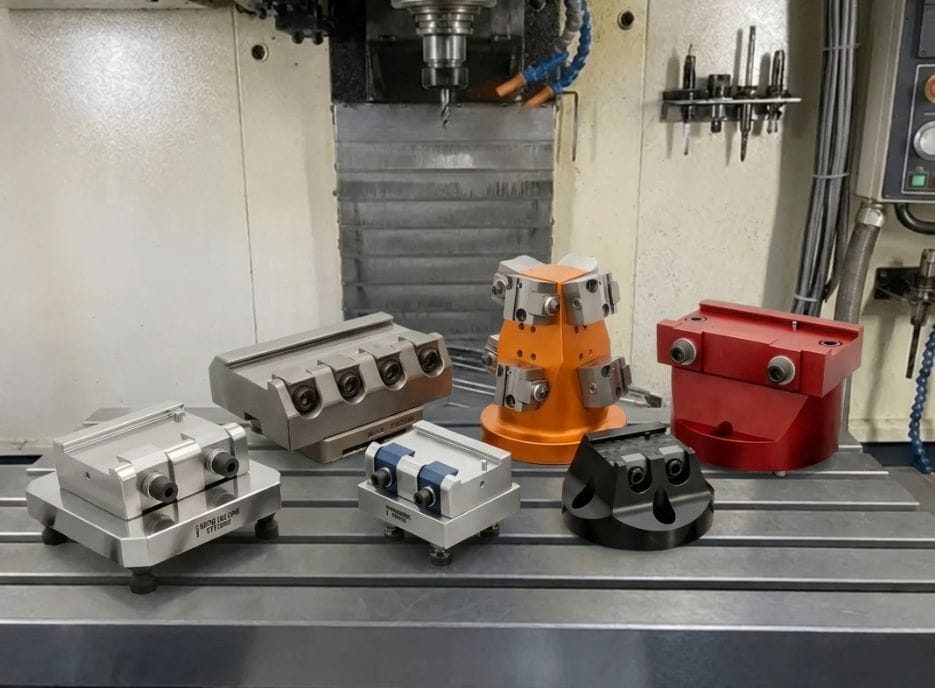
Sometimes the real problem is not centering the part. It is finding a way to hold the part without covering the surfaces you need to machine.
Dovetail workholding solves that by gripping a small prepared feature near the bottom of the stock. Because the fixture only needs a relatively small amount of material, much more of the workpiece stays exposed. This is useful when the tool needs to reach close to the bottom of the part or around complex external geometry.
A dovetail pallet for multi-surface machining is a good example of this approach. The part is prepared for the dovetail, clamped from a small area, and left open for machining on several faces.
Dovetail workholding is worth considering for:
- Complex 5-axis parts with a lot of external machining.
- Billet work where you want to expose as much material as possible.
- Aerospace-style components and other parts with deep side access.
- Jobs where normal vise jaws interfere with the cutter or holder.
- Parts that would otherwise require excessive stick-out.
There is a tradeoff. The stock usually needs a preparation operation before it can go into the dovetail fixture. On a one-off part, that extra step may not be worth it. On repeat work, the additional preparation can pay for itself by reducing later repositioning and giving you better access in the main machining cycle.
3. Zero-Point Workholding: Reduce the Time Between Jobs
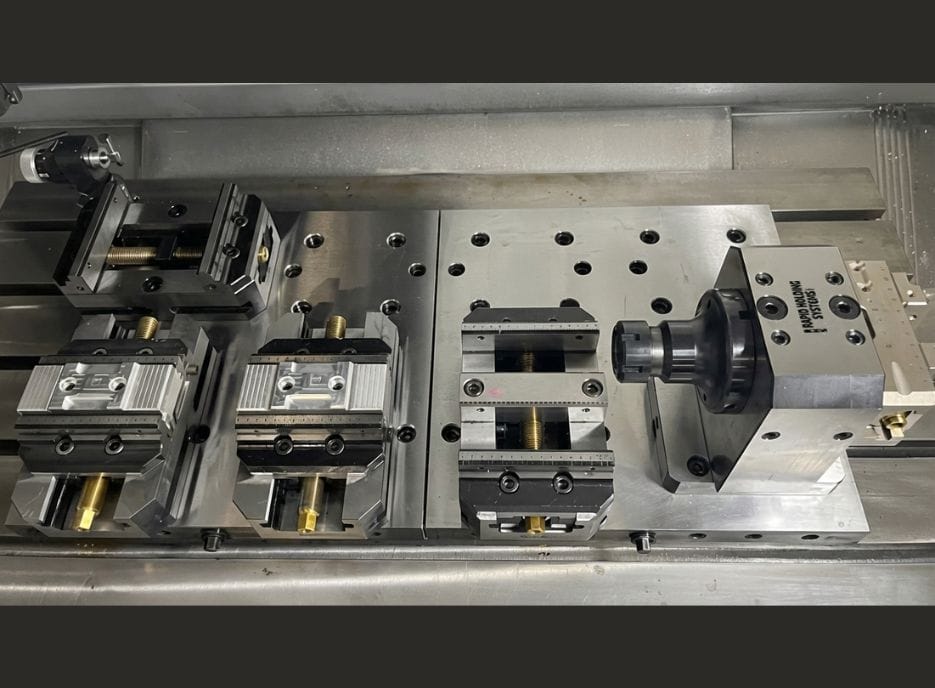
A self-centering vise holds the workpiece. A zero-point workholding system changes how the vise or fixture connects to the machine.
Instead of indicating and locating a fixture from scratch every time it goes back on the table, the zero-point base creates a repeatable mounting interface. The vise, pallet, or custom fixture can be removed and returned to that same interface later.
This becomes much more important as job variety increases. If one 5-axis machine runs a prototype in the morning, a repeat production job after lunch, and a custom fixture the next day, the fixture-change process can become a real source of idle time. Standardizing the mounting interface helps reduce that friction.
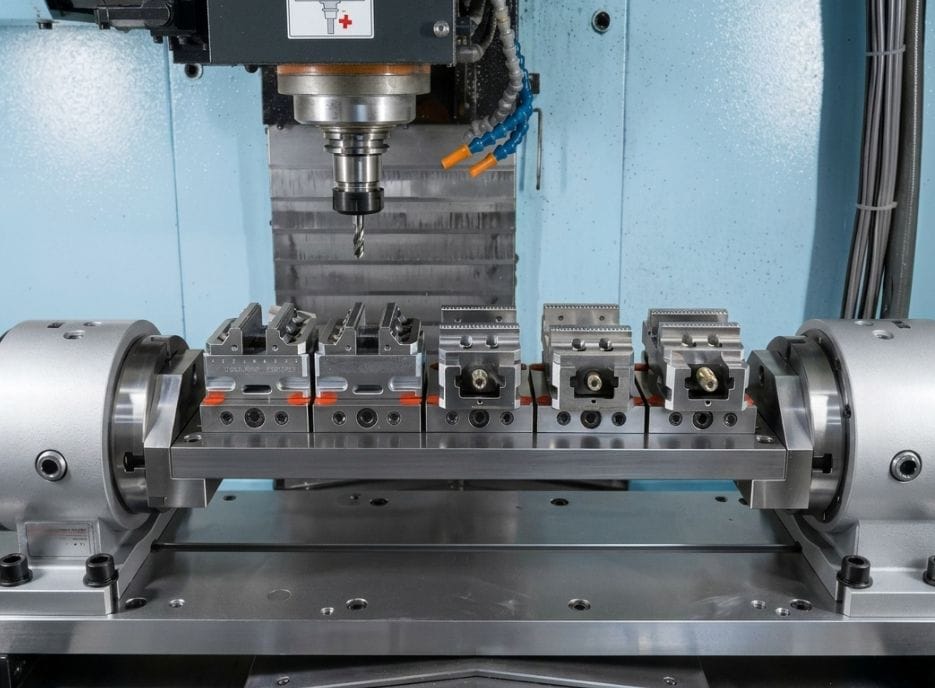
Zero-point workholding is especially useful for shops running:
- High-mix, low-volume production.
- Repeat jobs that return to the machine regularly.
- Multiple vise and fixture configurations.
- Parts that move between machining and inspection.
- Palletized or automation-ready processes.
RHS offers both 52 mm and 96 mm zero-point configurations. A low-profile Zero-Point Base Plate 52, 130 x 130 x 25 mm is useful when you want to keep stack height down, while a Zero-Point Plate 96, 192 x 156 mm gives another standardized mounting option for larger vise families.
Self-centering vise + zero-point base
These two systems solve different problems, which is why they work well together. The vise locates and clamps the workpiece. The zero-point base locates the vise. If the same machine runs several fixture types, this combination can be more useful than simply buying another conventional vise and indicating it every time it returns to the table.
4. Zero-Point 5-Axis Self-Centering Vises: One Compact Modular Setup
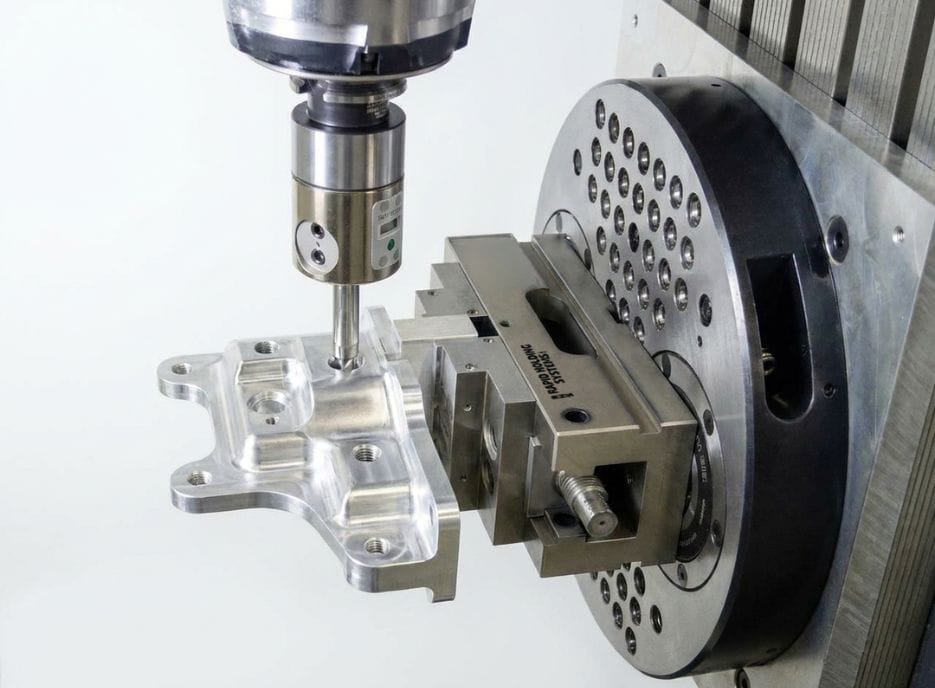
If you already know you want self-centering clamping and a standardized zero-point interface, you can combine both ideas into one workholding solution.
For example, the RHS Zero Point 5-Axis Self-Centering Vise 153 x 100 x 85 mm has a 0 to 79 mm clamping range, 10 kN clamping power, and repeatability of 0.01 mm or better. It uses a 52 mm zero-point interface.
The lower-profile 153 x 100 x 70.5 mm version increases the clamping range to 0 to 87 mm while reducing the overall fixture height. That lower height can matter when the spindle, holder, or rotary axis is already close to the edge of the machine envelope.
This is where it helps to stop thinking only about jaw width. Look at the complete stack from the machine table to the top of the workpiece. Every millimeter of fixture height changes where the part sits inside the machine and how much room the spindle has to move around it.
5. Pyramids and Tombstones: Put More Work in the Machine
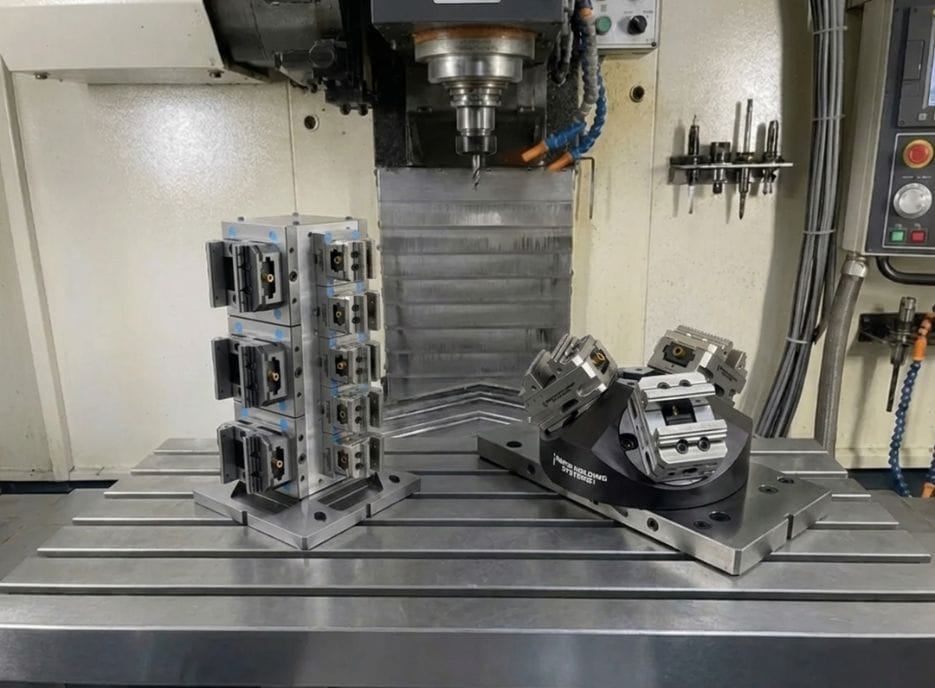
Sometimes setup time is not the main bottleneck. The operator is simply opening the door too often.
Pyramids and tombstones create additional mounting faces so you can place more vises, fixtures, or workpieces inside the machine at the same time. On the right part family, that can increase the amount of machining completed before the next operator visit.
A 3-Sided Pyramid with 3 x 96 Adapters creates three angled mounting stations on one fixture. Instead of treating the machine table as a single workholding position, you can use several faces of the available work envelope.
A pyramid or tombstone starts to make sense when:
- You can machine multiple identical parts in one cycle.
- Cycle times are short enough that the operator is loading frequently.
- You want longer unattended machining periods.
- Production volume is increasing.
- Your machine has enough envelope to use the extra stations without creating new clearance problems.
You can also browse RHS pyramids and tombstones if the goal is to build a multi-station 5-axis workholding layout rather than a single-vise setup.
The key is not to add stations just because the fixture allows it. More parts only help if the spindle can reach them safely and the added loading actually reduces operator intervention or improves machine utilization.
6. Dedicated and Custom Fixtures: When a Vise Is Not the Right Answer
Not every 5-axis part belongs in a vise. Castings, delicate components, highly irregular shapes, and high-volume repeat work may need a dedicated fixture built around the actual datums and machining surfaces of the part.
A custom fixture can locate from specific holes, surfaces, or reference features while leaving clearance exactly where the cutting process needs it. The tradeoff is flexibility. A self-centering vise can move from job to job. A dedicated fixture is usually built for one component or a narrow family of components.
For many shops, the practical middle ground is a dedicated fixture mounted on a standardized zero-point interface. The part gets the custom support it needs, while the fixture itself can still move on and off the machine without rebuilding the entire setup each time.
How to Choose a 5-Axis Workholding System
Before buying a vise, base, or fixture, walk through the setup in this order. These questions usually make the right option much clearer.
1. How large is the raw material and the finished part?
Start with the actual stock dimensions, not just the finished model. Check the clamping range, jaw width, fixture footprint, and the room needed for the spindle to reach the part.
A larger vise can feel safer, but if the fixture is oversized for the job you may lose valuable access for no real benefit.
2. How much of the part needs to be machined in the first setup?
If you only need the top and upper sides, a compact self-centering vise may be enough. If the cutter has to reach close to the bottom of the stock, a dovetail or elevated setup may make more sense.
3. How aggressive is the cut?
Tool access does not help if the workpiece moves. Consider material, tool diameter, depth of cut, cutting forces, part rigidity, and how much material is actually being clamped.
The best fixture is not the one with the most access. It is the one that gives you enough access without giving up the stability the cut requires.
4. How often will the workholding change?
If one vise stays on the machine for months, a quick-change interface may not be the first priority. If the table changes several times a day, zero-point workholding becomes much easier to justify.
The more time the spindle sits idle while a fixture is being indicated, aligned, or reinstalled, the more valuable a repeatable interface becomes.
5. Are you running one part or trying to increase part capacity?
For one-offs, a single compact vise may be exactly what you need. For production, look beyond the individual fixture.
Could you load two parts instead of one? Could a multi-position base, pyramid, or tombstone let the machine run longer before someone has to open the door?
6. Will this process be automated later?
You do not need a robot today to benefit from thinking ahead. Standardized pallets, predictable fixture locations, and repeatable mounting interfaces make future automation easier to plan.
A shop that builds around a common interface now usually has more options later than a shop with a collection of unrelated one-off setups.
What Should You Buy First for a 5-Axis Machine?
Start with the jobs you actually expect to run, not the biggest system you can fit on the table.
For a high-mix job shop, a compact self-centering vise and a zero-point base are often a practical first combination because they handle different part sizes while giving you a repeatable mounting strategy.
If most of your work needs machining close to the bottom of the stock, look at dovetail workholding early. If the bigger problem is fixture changeover, prioritize the zero-point interface. If the machine is already busy and you are trying to increase the amount of cutting between operator visits, then multi-station plates, pyramids, or tombstones deserve a closer look.
There is no rule that every job in the shop has to use the same fixture. The better goal is to build a workholding ecosystem where the right fixture can be installed without rebuilding the machine setup every time.
5-Axis Workholding FAQ
What is the best workholding for 5-axis machining?
For general high-mix machining, a compact self-centering vise is often the most flexible starting point. Dovetail workholding is better when maximum part access matters, while zero-point systems are more valuable when fixtures change frequently.
Is a self-centering vise good for 5-axis machining?
Yes. Self-centering vises are commonly used in 5-axis machining because they center the workpiece, keep the fixture relatively compact, and can handle a range of part sizes. The correct size still depends on the workpiece, cutting forces, and required access.
What does a zero-point system do?
A zero-point system creates a repeatable mounting location for a vise, pallet, or fixture. It is designed to reduce the amount of locating and indicating required when workholding is removed and later returned to the machine.
When should I use dovetail workholding?
Use dovetail workholding when the cutter needs access to most of the outside of the part, especially near the bottom. The tradeoff is that the stock normally needs a dovetail preparation feature before the main machining setup.
Do pyramids and tombstones always increase productivity?
No. They help when additional stations let the machine run more parts or longer cycles between operator visits. If the machine envelope is tight or the extra stations create difficult tool access, adding more workholding can create new problems instead of solving them.
How important is fixture height in 5-axis machining?
Very important. Fixture height affects spindle clearance, tool reach, collision risk, and how much of the machine envelope remains usable. Always evaluate the full stack from the machine table to the top of the workpiece.
Build the Right 5-Axis Workholding Setup
Good 5-axis workholding should do three things: keep the part rigid, give the cutting tool the access it needs, and make the next setup easier rather than harder.
Rapid Holding Systems offers self-centering vises, zero-point bases, dovetail workholding, pyramids, tombstones, and modular fixture components for CNC and 5-axis machining. If you are not sure which combination fits your machine or part, send us your workpiece dimensions, machine information, or part drawing. We can help you narrow the setup based on the actual application.
Email: [email protected]
High-quality and affordable tooling for CNC, EDM, and Wire EDM applications.
Related Posts
CNC Tooling, EDM Tooling, WEDM Tooling

5 Shop Floor Horror Stories That Better Workholding Can Help Prevent
Some shop-floor problems start small. A part shifts during machining. A preset fixture needs another adjustment. A Wire EDM cut...
CNC Tooling, EDM Tooling
Modular, Quick-Change, and Zero-Point: What Each Approach Does—and When It Actually Makes Sense to Use It
Workholding decisions shape more than setup time. They define how stable a process is, how parts move through the shop, and...
CNC Tooling, EDM Tooling, WEDM Tooling
What Is a Reference System and Why It Changes How Parts Move Between Machines: CNC → EDM → Wire EDM Without Realignment
In many shops, every machine treats the part as if it were new. Each operation begins by re-establishing alignment, finding...