
 248-250-8937
 519-999-9723
 +1 844 686-0671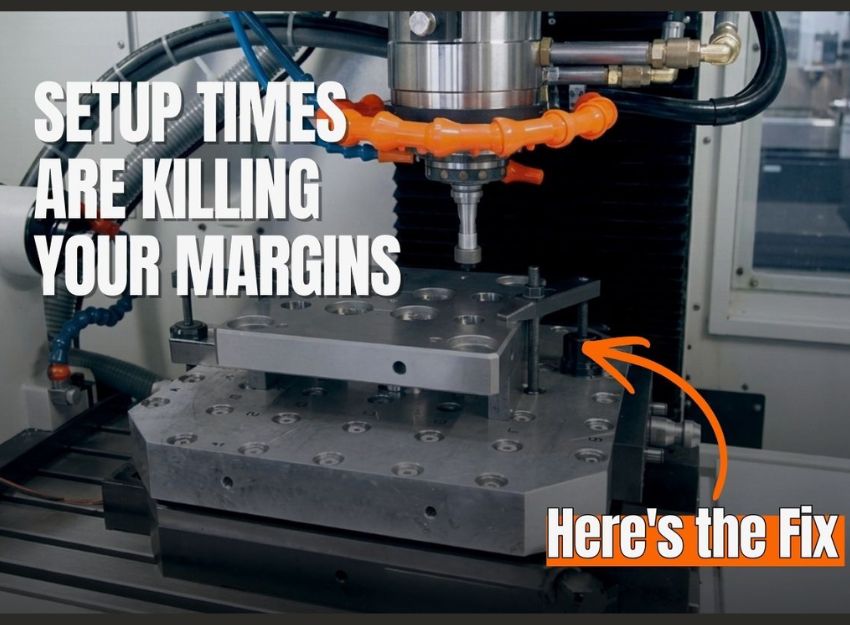
How MTS and EROWA UPC Compatible Pallet Systems Cut CNC Setup Time Without Sacrificing Precision
Your Operators Are Still Indicating Parts by Hand, You're Leaving Money on the Table
Every CNC and EDM shop has a version of the same problem: a job change hits the floor, and suddenly your best machinist is spending 45 minutes cleaning, indicating, resetting fixtures, and chasing runout on a part he set up last week.
That's not a skill problem. That's a system problem.
Quick-change pallet systems (specifically MTS and EROWA UPC compatible platforms) exist precisely to eliminate this bottleneck. When done right, palletized workholding compresses changeover from 30–60 minutes down to seconds, with repeatability under ±0.005 mm. No re-indicating. No guesswork. No wasted spindle time.
The Hidden Cost of Manual Setups
Setup time rarely shows up on a P&L as a line item, but it's there. It lives in overtime, scrapped parts, late deliveries, and operators who spend more time loading fixtures than running programs.
Consider what a typical manual changeover actually involves:
- Pulling and cleaning the previous fixture
- Indicating the new part into position
- Checking runout and re-zeroing offsets
- Verifying clamping force and rigidity
- Running a test pass before committing to production
In a high-mix, low-volume shop, that sequence can repeat five, eight, ten times a day. At 30–45 minutes per changeover, the math is brutal. A shop running 10 setups a day could be losing five to seven hours of productive spindle time each day.
The hidden costs compound from there:
- Alignment errors introduce human variability. Even experienced operators have off days, and a missed tenth can mean a scrapped part or a rework loop that costs more than the job was worth.
- Operator bottlenecks pull skilled people away from programming, inspection, and optimization. That's the work that actually grows the business.
- Inconsistent positioning leads to unpredictable surface finishes and tolerance stack-ups that create quality headaches downstream.
Zero-point clamping and palletized workholding are designed to solve all of this at the root.
How MTS and EROWA UPC Compatible Pallet Systems Help
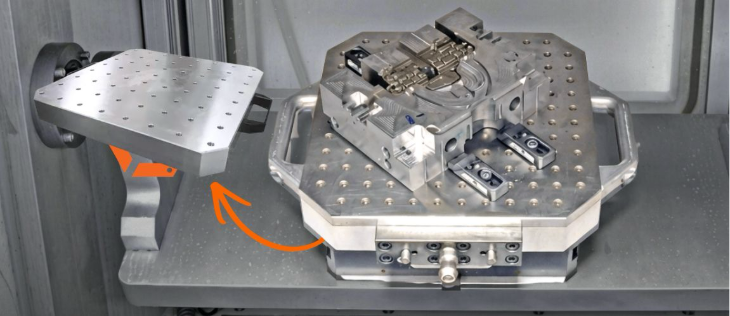
Understanding the two primary platforms helps you match the right system to your application.
MTS Pallet System
The MTS system is built for versatility. Base plates can be configured for single-chuck work or multi-chuck batch setups, and modular plates are available in 1 to 8 chuck configurations. Key advantages include:
- MTS 3.0: A self-locking mechanism that holds the chuck secure even if air pressure is lost, which is critical for safety and unmanned operation. An integrated air circuit verifies that the spigot is seated and locked before machining begins.
- MTS 4.0: Adds wireless digital status monitoring so machine controls can display real-time chuck conditions. Operates on just two pneumatic lines and simplifies lights-out management.
- Self-cleaning contact surfaces during changeover keep the reference datum clear of chips and coolant without manual intervention.
EROWA UPC Compatible System
For applications requiring the tightest tolerances, EROWA UPC compatible pallets deliver repeatability below ±0.002 mm with 4 × 90° indexing capability. Key features:
- Hardened supports and precision centering segments
- Pull-down forces up to 50 kN
- Sealed design that protects against coolant and chip ingress
- Compatible with tombstones and plates to maximize working envelope
Both platforms allow operators to fixture parts offline, away from the machine, so the spindle keeps running while the next job is being prepared.
Where RHS Compatible Pallets Fit Into the Workflow
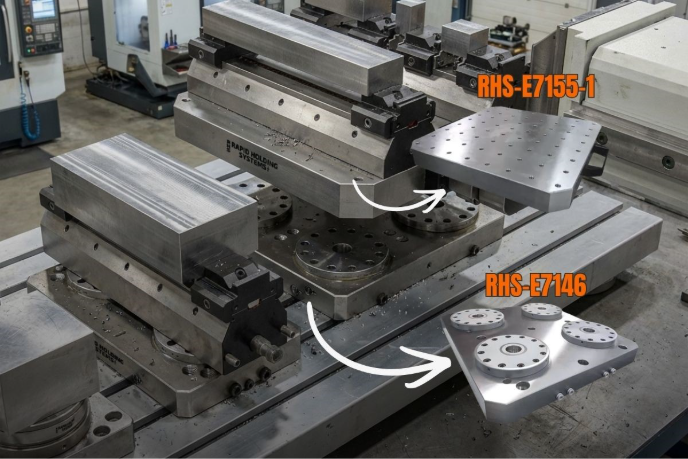
Rapid Holding Systems manufactures pallets and chucks that are 100% compatible with EROWA MTS and UPC systems, engineered to the same dimensional standards and surface hardness specs.
Here's how RHS compatible tooling slots into a typical shop workflow:
- Offline fixturing: Parts are fixtured to RHS pallets at a separate workstation while the machine runs the current job.
- Zero-point drop-in: When the machine is ready, the pallet drops onto the chuck, self-cleans the contact surface, and locks with spring-powered force. No indicating required.
- Immediate machining: With repeatability ≤ 0.005 mm, the program runs from the same datum as the last cycle. First-part confidence is built into the system.
- Scalable automation: All RHS pallets are compatible with robotic grippers, so the same tooling you use for manual operation today can integrate into an automated cell tomorrow.
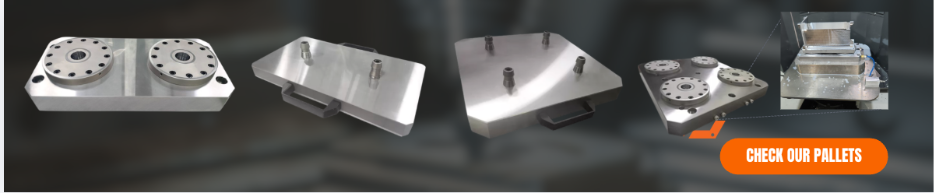
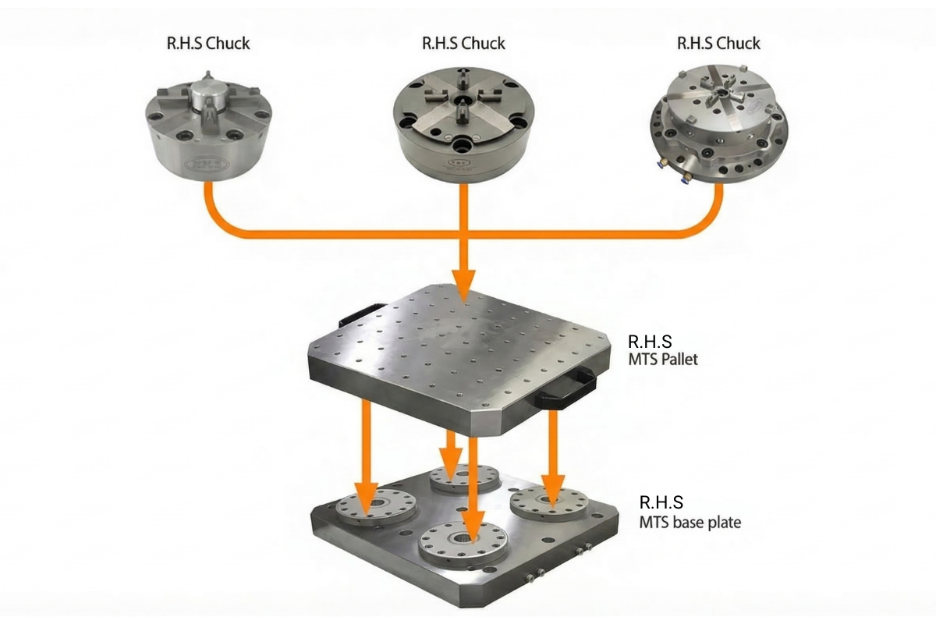
RHS's unique modular adaptation allows multiple EROWA-compatible chucks to be mounted on a single MTS pallet, with a coupling module supplying compressed air or hydraulics as required. You can start with a single chuck and scale to multi-chuck plates or tombstones as your workload grows.
How to Know If Your Shop Is Ready for Palletization
Not every shop is at the same starting point. Here are some practical indicators that palletized workholding will deliver a clear return:
- You're running more than 5 setups per day: the ROI math becomes compelling quickly at this volume.
- Your part mix changes frequently: high-mix, low-volume production is where zero-point systems shine.
- Alignment errors are showing up in your scrap or rework rate: this is a system problem, not an operator problem.
- You've considered lights-out or unmanned shifts but haven't had the positional consistency to make it work.
- You're currently running EROWA MTS or UPC plates and want a more cost-effective tooling option without requalifying your process.
With the right adaptation, you can mount multiple EROWA Compatibles chucks directly onto MTS pallets and keep your operation simple and repeatable
Ready to Recover That Setup Time?
Manual setups are not inevitable. They are a process choice. And with MTS and EROWA UPC compatible pallet systems, there's a clear, proven alternative that reduces changeover time, eliminates re-indication, and creates a real path toward automation.
Book a quick call or request a product recommendation from the RHS team. Tell them what machines you're running, what your typical job mix looks like, and how your current fixturing is set up. They will help you find the configuration that makes the most sense for your shop.
Your spindle time is too valuable to spend on setups that can be eliminated.
Related Posts
EDM Tooling

EDM Automation at IMTS 2026: See a 4-Head EDM Machine and Robotic Tool Changing in Action
What if you could get more production from your EDM process without simply adding more machines?Or automate your EDM operation...
EDM Tooling
Which EDM Drawbar Do You Need? A Complete Guide to Spigots, Retention Knobs, and EDM Chucks
Avoid compatibility mistakes by understanding which spigot or retention knob works with your EDM setup.If you've ever ordered a...
EDM Tooling
Why Standard EDM Pallets Make Rib Burning Harder (And How Custom Holders Solve It)
If you've ever tried to burn long ribs around deep cavities or tall mold walls, you've probably run into the same frustration. Your EDM machine has the...