
 248-250-8937
 519-999-9723
 +1 844 686-0671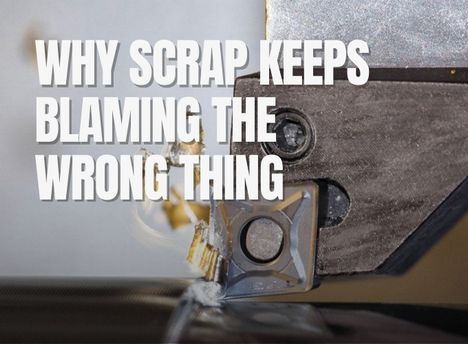
Why CNC Scrap Often Gets Blamed on the Wrong Thing
When scrap appears in CNC machining, the first reaction is usually immediate. The tool gets blamed, the program gets adjusted, or the operator gets questioned. These are the most visible parts of the process.
Often, the correction seems to work. A parameter change removes the scrap, production resumes, and the issue is considered solved.
Until it happens again.
Why Scrap Diagnosis Is So Difficult
This cycle is common because scrap rarely shows its real cause right away. Instead, it appears intermittently. That inconsistency is what makes diagnosis difficult.
Tooling is frequently the first suspect. Worn edges, broken inserts, or chatter are easy to see and easy to replace. But tools often reveal instability rather than create it.
Operators are another common target. If scrap happens on one shift and not another, the conclusion feels obvious. In reality, operators are often compensating for underlying variation.
Programs also take the blame. Offsets get adjusted, depths get corrected, and paths get modified. The part measures fine again, but the root problem remains untouched.
Where the Real Problem Usually Hides
In many cases, the real cause lives earlier in the process. Workholding that moves slightly under load. References that shift between setups. Clamping forces that change the part shape without being noticed.
These issues don't cause constant scrap. They cause occasional scrap. That's what allows them to survive for so long.
When scrap disappears after an adjustment but returns later, the process was never stable. The correction treated the symptom, not the system. Variation was managed, not removed.
The Real Pattern Behind Intermittent Scrap
Scrap that behaves inconsistently is rarely caused by a single component. It's usually the result of small instabilities stacking together. Each one alone looks harmless.
Understanding why scrap gets blamed on the wrong thing is a shift in mindset. It requires looking beyond what failed last and questioning what was assumed to be stable.
Scrap is not always a tooling problem. It's often a process problem showing up late.
About Rapid Holding Systems
At Rapid Holding Systems, we understand the reality of the shop floor. When setups fail, it's not just a tool problem—it's lost time, missed deadlines, and unnecessary stress. For over 20 years, we've specialized in precision-compatible workholding solutions for CNC, EDM, and Wire EDM operations. We work with manufacturers who demand repeatability, not excuses, providing proven compatibility with System 3R and EROWA systems backed by real-world application knowledge. From standard solutions to custom tooling, we help precision manufacturers achieve faster setups, improved accuracy, and the confidence that their tooling will perform consistently—every single time.
Want to solve your setup challenges? Reach out at [email protected]
Related Posts
CNC Tooling, EDM Tooling, WEDM Tooling

5 Shop Floor Horror Stories That Better Workholding Can Help Prevent
Some shop-floor problems start small. A part shifts during machining. A preset fixture needs another adjustment. A Wire EDM cut...
CNC Tooling
5-Axis Workholding Guide: How to Choose the Right Vise, Zero-Point System, Dovetail or Fixture
A 5-axis CNC can reach more of the part in one setup, but only if the workholding stays out of...
CNC Tooling, EDM Tooling
Modular, Quick-Change, and Zero-Point: What Each Approach Does—and When It Actually Makes Sense to Use It
Workholding decisions shape more than setup time. They define how stable a process is, how parts move through the shop, and...