
 248-250-8937
 519-999-9723
 +1 844 686-0671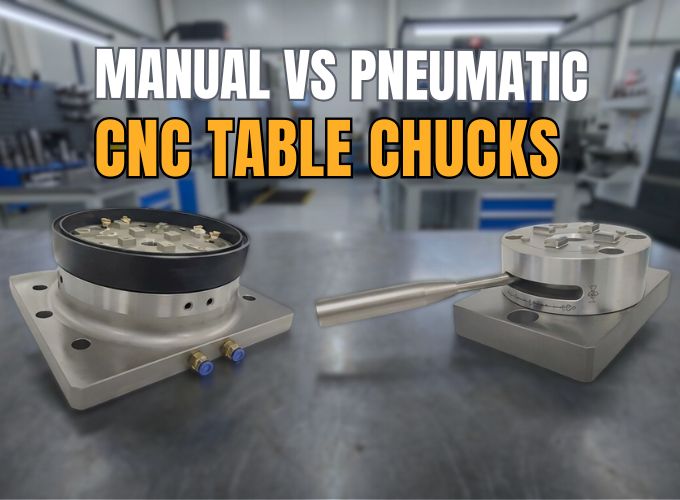
Manual vs Pneumatic CNC Table Chucks: Choosing the Right System 3R‑Compatible Setup
Every minute spent re‑indicating a part is a minute not cutting. In production CNC environments that cost compounds quickly. Setup variability between shifts, inconsistent holding force during aggressive cuts and the inability to move work between machines without losing your datum translate directly into re‑work, scrap and lost tool life. A standardized pallet system solves these headaches by encoding the datum directly into the tooling. This article explains how System 3R‑compatible CNC table chucks work, how manual and pneumatic versions differ mechanically and how to select a setup that fits your shop. Where appropriate we’ve added links to the Rapid Holding Systems product pages so you can explore the exact products discussed.
Why CNC repeatability breaks down
Most shops start with vises. A vise gets the job done, but it does not give you a repeatable datum. Every time a part is removed and replaced the position changes. Every time a setup moves to a different machine you start from scratch. When a different operator runs the same job, the result may differ slightly from the previous shift. Those inconsistencies accumulate – they’re manageable in prototype work but a problem in production. Inconsistent clamping force during steel roughing leads to chatter, deflection and surface finish issues. The underlying issue is always the same: no fixed, repeatable datum in the workholding system.
Understanding the System 3R pallet system
A System 3R‑compatible pallet system works on a simple principle. The chuck mounts permanently to the machine table. The pallet carries the workpiece or fixture. When the pallet engages the chuck it locks onto a precise mechanical datum that repeats to within microns every time. The datum is established through the spigot on the underside of the pallet. As the chuck locks it pulls the pallet down onto the datum faces and clamps it. The result is a known repeatable X, Y and Z position on every insertion. A part can be removed for offline inspection, measured on a CMM and returned to the machine in the same position without re‑indicating. The same pallet can move between any machine fitted with a compatible chuck and locate accurately without additional setup work.
At Rapid Holding Systems (RHS), System 3R‑compatible pallets and chucks follow these standards so shops can mix and match components from different suppliers. For example, their 54 mm pallet is available as a precision ground 54×54 mm unit with hardened faces and four index positions. You can see the product details here: 3R Compatible 3R‑651.7E‑XS pallet 54 mm Macro. For larger workpieces there’s a 70 mm pallet option such as the System 3R 3R‑601.1E‑P compatible pallet 70×70 mm, which provides a larger footprint while preserving the same datum geometry.
Manual CNC chuck operation
The traditional way to clamp a pallet into the System 3R chuck uses a mechanical screw. RHS offers a direct replacement for the OEM manual chuck: the System 3R 3R‑610.21 Manual Chuck Macro. It uses a short spigot on the pallet to locate the assembly, then an Allen key draws the pallet down onto the datum faces. Releasing the pallet reverses the process. This chuck requires no air supply and minimal maintenance. For low‑to‑medium volume production, standalone machines or shops where automation isn’t on the horizon, it’s a cost‑effective way to standardize the datum. You can read more about this chuck and order it online here: System 3R 3R‑610.21 manual chuck Macro.
When to choose a manual chuck:
- You run jobs in small batches and change pallets infrequently.
- Your machines are standalone and not integrated into an automated cell.
- You value simplicity and want minimal infrastructure – no air lines or additional control signals are needed.
- You’re establishing a datum system for the first time and want an affordable entry point.
Pneumatic CNC chuck operation
As production volumes rise the manual Allen key becomes the bottleneck. A pneumatic chuck removes the wrench and replaces it with compressed air actuation. The System 3R 3R‑600.10‑30 compatible pneumatic table chuck MacroHP uses a longer spigot on the pallet to accommodate the internal air‑driven mechanism. The chuck body has two air inlets – one to clamp and one to release. Connecting shop air to the engage port draws the pallet onto the datum under pressure; connecting air to the release port frees it. The active actuation in both directions gives consistent clamping force and predictable cycle times. Robots and pallet changers can interface directly with the chuck’s pneumatic ports for fully automated loading. Learn more about this chuck here: System 3R 3R‑600.10‑30 compatible pneumatic table chuck MacroHP.
When to choose a pneumatic chuck:
- You change pallets frequently and changeover time directly affects output.
- Your machine is part of an automated cell or uses robotic loading.
- You want to integrate pallet engagement with machine control logic or PLCs.
- You need speed and consistency to maximize machine utilization.
54 mm vs 70 mm pallet systems
Two common pallet sizes support System 3R setups for smaller workholding applications. Both sizes use the same datum geometry; the difference is footprint and holding force.
54 mm pallets are often associated with graphite electrode machining because sinker EDM workflows favour a smaller pallet. However there’s no technical reason to limit them to graphite. A hardened 54 mm pallet like the 3R‑651.7E‑XS 54 mm Macro pallet can be used for steel components if the part size and cutting forces fall within its capability. This size is ideal for small parts, electrodes or fixtures where machine envelope and tool access are at a premium.
70 mm pallets provide a larger contact area and higher holding force. A pallet such as the 3R‑601.1E‑P 70×70 mm Macro pallet is better suited for larger workpieces, heavier fixtures or more aggressive milling. The increased diameter distributes clamping loads and provides more stability during high‑feed machining. When selecting a pallet size consider part dimensions, fixture geometry and the cutting forces you expect; the material itself (steel versus graphite) is less important than those factors.
What about the Macro Magnum?
For heavy‑duty machining there is a larger format known as the Macro Magnum. Its 6.5 inch (165 mm) pallet distributes clamping force over a much wider area and can generate holding forces around 16 000 Nm. This makes it suitable for aggressive stainless steel or Inconel roughing on 3‑ or 5‑axis machines. RHS supplies Macro Magnum chucks with a slotted base plate to bolt directly to your table. If your parts exceed the limits of the 54 mm and 70 mm system or you need maximum rigidity, contact Rapid Holding Systems for options – the Macro Magnum chuck isn’t listed on the website yet but the team can quote it on request.
Manual vs pneumatic: comparison summary
| Feature | Manual chuck | Pneumatic chuck |
| Engagement method | Allen key | Compressed air |
| Spigot type | Short | Long |
| Actuation direction | Screw tighten/release | Active clamp & release ports |
| Changeover speed | Moderate | Fast |
| Air supply required | No | Yes |
| Automation suitability | Limited | Full |
| Best use case | Low‑to‑mid volume, standalone machines | High volume, automated cells |
Both systems use the same pallet datum and deliver repeatable location accuracy. The difference lies in how clamping force is applied and how well the chuck integrates into your workflow.
Choosing the right System 3R‑compatible setup
Ultimately your choice depends on production volume, changeover frequency and automation intent:
- Entry‑level shops should start with a manual chuck and a set of 54 mm or 70 mm pallets. The upfront cost is lower and you can standardize your datum without installing air lines. As your business grows, you can retrofit a pneumatic chuck onto the same table and reuse all pallets.
- High‑volume or automated cells benefit from the pneumatic chuck immediately. Fast clamping cycles and integration with robots or pallet changers keep spindles cutting instead of waiting on manual intervention. When paired with 70 mm pallets, the pneumatic chuck forms the backbone of a scalable production cell.
- Heavy‑duty 5‑axis machining may justify the Macro Magnum with its larger pallet and extreme holding force. Contact RHS to discuss your specific application.
Pallet standardization resolves the repeatability problem at its source. When the datum is fixed in the tooling rather than re‑established at each setup, setup time drops, scrap decreases and machine utilization improves. System 3R‑compatible chucks and pallets from Rapid Holding Systems provide standardized datums in formats that suit a range of applications. Whether you start with a manual chuck and 54 mm pallets, upgrade to a pneumatic chuck with 70 mm pallets, or move to a Macro Magnum for heavy roughing, the underlying principle stays the same: get the datum right and everything else becomes easier. Explore the linked products above and contact Rapid Holding Systems if you need help choosing the best configuration for your shop.
Related Posts
EDM Tooling
System 3R-Compatible Wire EDM Workholding: A Guide to Precision and Efficiency
Wire EDM lets you cut intricate shapes with micron-level accuracy. But that precision depends just as much on...
EDM Tooling
How MTS and EROWA UPC Compatible Pallet Systems Cut CNC Setup Time Without Sacrificing Precision
Your Operators Are Still Indicating Parts by Hand, You're Leaving Money on the Table Every CNC and EDM shop has a version of...
EDM Tooling
CNC Pull Clamps: Fewer Setups, More Machining Access
What Are CNC Pull Clamps? CNC pull clamps are modular workholding systems that secure a part from below instead of from the top or sides. They use a...