
 248-250-8937
 519-999-9723
 +1 844 686-0671
How a five-Part Prototype Paved the Way for a 57-Part Wire EDM Production System
A custom aerospace workholding project developed with Mitsubishi for a new Wire EDM installation.
A new Wire EDM machine can offer impressive accuracy and long unattended run times. But only if the workholding can keep up.
That was the challenge facing an aerospace manufacturer during the installation of a new Mitsubishi Wire EDM.
The customer needed to eventually hold 57 small, tight-tolerance aerospace parts in a single setup. The goal was to load more parts at once, reduce operator intervention, and keep the machine cutting unattended for longer periods.
The machine had the capability. The challenge was building a workholding setup that could take advantage of it without compromising the precision the parts required.
The Customer Needed More Than a Standard Fixture
The planned production setup called for three rails with 19 parts on each rail, for a total of 57 parts.
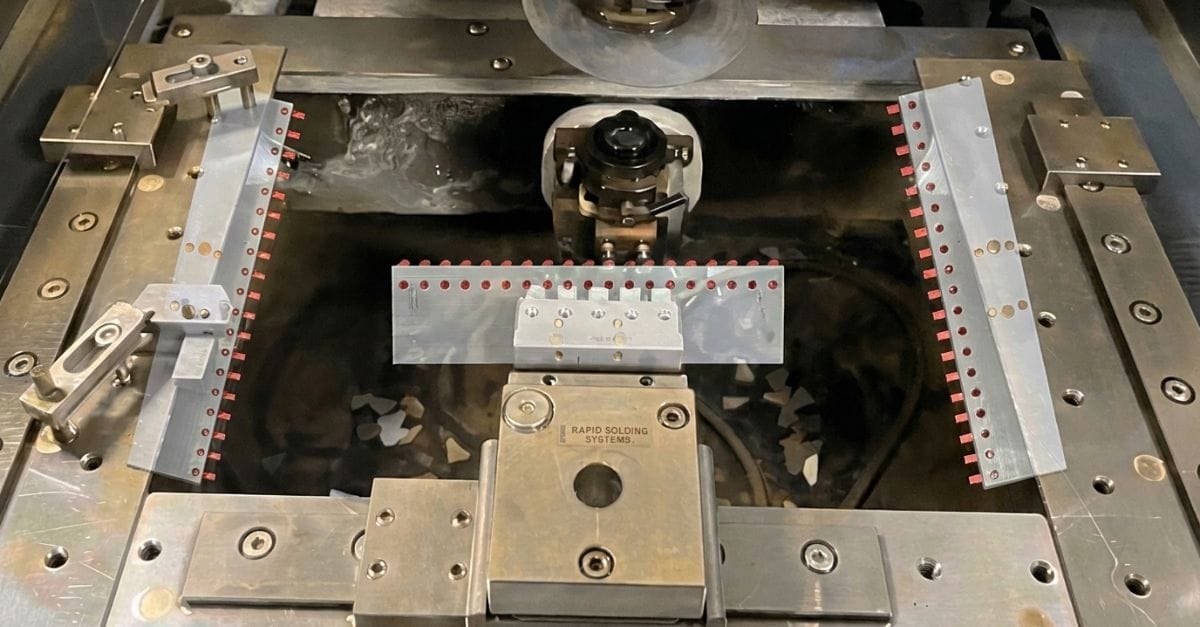
(project idea)
But part density was only one piece of the problem.
Because this was a tight-tolerance aerospace application, every part needed to stay stable and consistently positioned throughout the Wire EDM process. The setup also had to provide proper wire access while fitting within the available machine space.
An off-the-shelf fixture wasn't designed around this exact combination of part count, tolerance requirements, machine configuration, and production goals.
The customer needed a workholding solution built around the application.
Working with Mitsubishi on the New Machine Installation
Rapid Holding Systems worked alongside Mitsubishi and the end user throughout the project.
That collaboration mattered because the fixture was being developed for a brand-new Mitsubishi Wire EDM installation. The workholding needed to support the machine's precision capabilities, not become the weak point in the process.
This also wasn't a project that could be solved by picking an existing standard fixture off the shelf.
Instead, the teams worked through the application requirements together and developed a custom, modular approach. One that could support the immediate production need while also giving the customer flexibility for future projects.
Why We Started with a Prototype
Rather than manufacture the entire 57-part system right away, the project began with a smaller prototype.
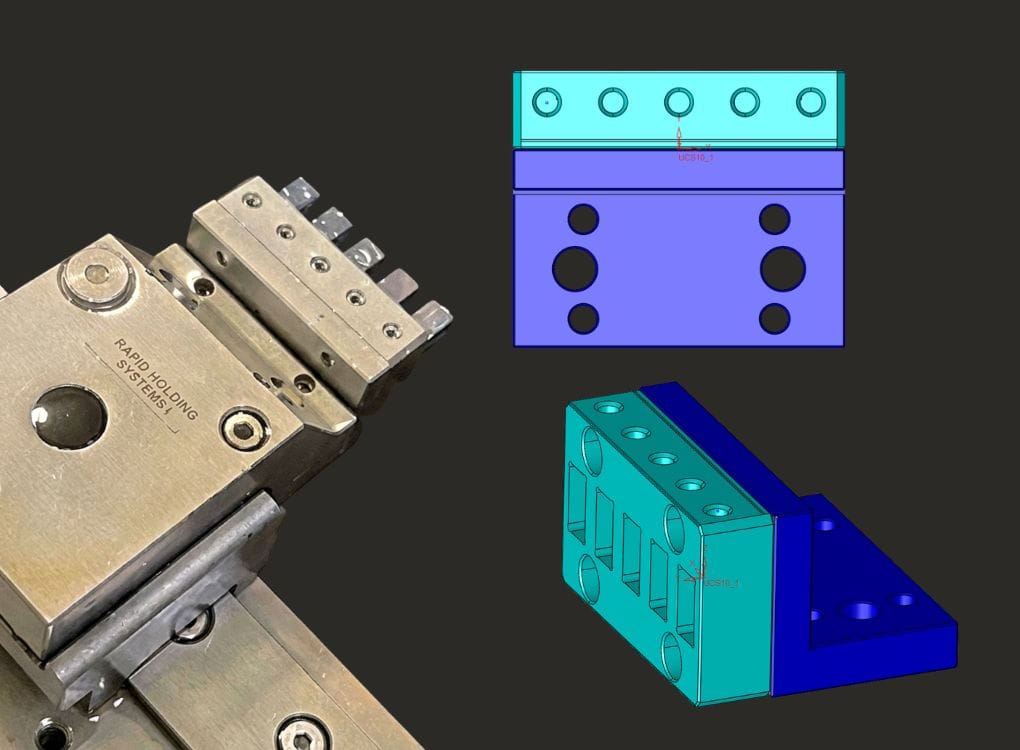
The prototype let the customer test the concept directly on the actual machine before committing to the full production fixture.
It was used to validate:
- Part positioning
- Wire access
- Fixture stability
- Mounting and clamping
- Repeatability under real machine conditions
This approach reduced risk. Instead of assuming a complete system would work based only on CAD models and calculations, the customer could see exactly how the workholding performed in a real production environment.
The Prototype Performed as Intended
The prototype was installed and tested directly on the customer's Mitsubishi Wire EDM.
The results were positive. The fixture mounted correctly, the parts positioned as planned, the machine had the wire access it needed, and the system stayed stable throughout testing.
Most importantly, the prototype performed as intended under the customer's actual machine conditions.
That successful test gave the customer confidence to move forward with the complete 57-part production system.
A Modular System Built for More Than One Job
One of the most valuable parts of this project was the modular approach.
The goal wasn't to create a one-time fixture that solved a single production problem. Instead, the system was built around a modular workholding platform the customer could continue using and adapting for future applications.
That gives the customer more flexibility as production needs change. Instead of starting from zero on every new part or project, the modular system provides a foundation that can be expanded or adapted for future Wire EDM work.
The Bigger Goal: Getting More Out of the Machine
The real objective of this project was never simply to fit 57 parts inside a Wire EDM.
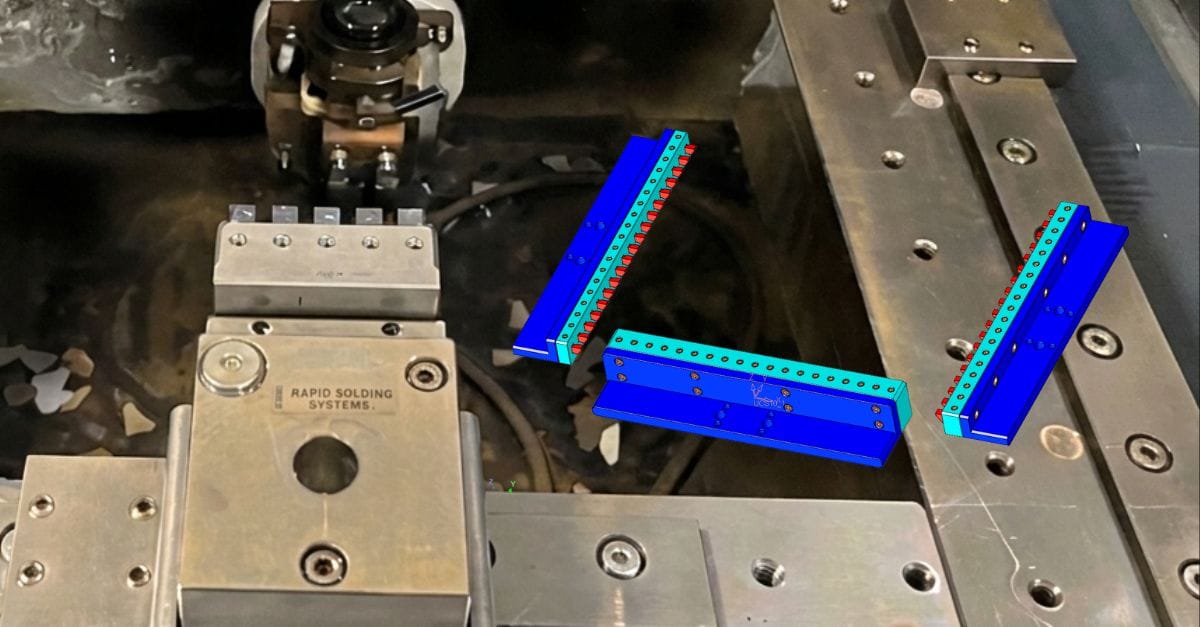
It was to help the customer make full use of the capability already built into the machine.
With the complete system, the customer is working toward a setup that supports more parts per cycle, fewer loading interruptions, less operator involvement, and longer periods of unattended machining.
The final 57-part configuration hasn't been completed and production-tested yet, so those production improvements still need to be measured once the full system is in place.
What has already been proven is the underlying workholding concept. The prototype demonstrated that the planned approach works on the customer's machine, providing a validated path toward the complete production fixture.
s Your Workholding Limiting Your Wire EDM Production?
If you need to hold more parts, run longer unattended cycles, or fixture an application that standard tooling can't handle, you don't necessarily need to redesign your entire production process.
Start with the application.
Send Rapid Holding Systems your part drawing, machine information, and production challenge. We'll help you determine whether a standard, modified, or custom workholding solution is the right fit for your setup.
Email us: [email protected]
Rapid Holding Systems helps CNC, EDM, and Wire EDM shops run production with confidence through high-quality, affordable tooling.
Related Posts
CNC Tooling, EDM Tooling, WEDM Tooling
What Is a Reference System and Why It Changes How Parts Move Between Machines: CNC → EDM → Wire EDM Without Realignment
In many shops, every machine treats the part as if it were new. Each operation begins by re-establishing alignment, finding...
CNC Tooling, WEDM Tooling
Setup Time Reduction: What You Really Gain When You Move from Internal Adjustments to External Preparation
In many CNC shops, setup time is treated as something to be minimized at the machine. The focus is often...
WEDM Tooling
Why Your Wire EDM Jobs Never Turn Out the Same (And How to Fix It)
If you run Wire EDM regularly, this situation probably sounds familiar: You repeat the same job using the same program and the same machine. But...